Xbox Game Pass Ultimate currently has a materially larger US catalog than Premium. In our August 11, 2026 production snapshot, the currently playable set contained 951 Ultimate games and 595 Premium games; 356 Ultimate games had no playable Premium match. “Playable” includes available, newly added, and leaving-soon records, but excludes coming-soon entries.
Including the tracked pipeline changes the figures to 960 non-left Ultimate games, 595 Premium games, and a 365-game difference because nine Ultimate entries are still coming soon. Neither figure is a permanent “Ultimate exclusive” list. Catalogs rotate, games move between statuses and plans, and availability differs by region, platform, and edition. Use the live Game Pass games list and our plan comparison for a current personal check.
Ultimate vs Premium games list: the current US snapshot
| Catalog measure | Available distinct games | What it means |
|---|---|---|
| Currently playable Ultimate | 951 | Available, new-this-month, or leaving-soon US records |
| Currently playable Premium | 595 | Same playable-status definition |
| Playable Ultimate minus Premium | 356 | Playable Ultimate games with no playable Premium match |
| All tracked non-left Ultimate | 960 | Playable set plus 9 coming-soon records |
| All tracked non-left Premium | 595 | No Premium coming-soon rows at this cutoff |
| Non-left Ultimate minus Premium | 365 | Includes coming-soon differences; not all are playable |
| Premium minus Ultimate | 0 | No Premium-only game in either snapshot |
We calculated these figures using distinct game records, not raw catalog rows. The currently playable query accepts three explicit states: AVAILABLE, NEW_THIS_MONTH, and LEAVING_SOON. It excludes COMING_SOON because an announced game is not yet playable. The broader non-left view is useful for planning, but it cannot be described as the current playable library.
Xbox’s own plan page uses rounded library sizes because the total changes. It also warns that titles, numbers, features, and availability vary by time, region, plan, and platform. Our higher database total should not be presented as a contradiction: data models can count editions, legacy titles, platform variants, or bundled-library entries differently. The only safe use of the numbers is a transparent, same-dataset comparison.
The practical takeaway is the ratio, not a promise of 951 permanent downloads. Premium covered well over half of the currently playable Ultimate set, while Ultimate supplied the entire Premium set plus another 356 playable records. Search the current catalog immediately before upgrading or downgrading, and filter by your actual platform. A cloud listing is not automatically a PC download, and a PC entitlement is not automatically a console license.
What games are in Ultimate but not Premium?
The difference is not one coherent “exclusive games” shelf. It is the union of several access paths: new games that Ultimate receives on day one, games supplied through EA Play or Ubisoft+ Classics, and other titles Xbox has placed in Ultimate but has not yet moved into Premium. That is why a simple alphabetical dump tells you less than the plan and source behind each record.
Representative Ultimate-not-Premium records in our August 11 US snapshot included Alice: Madness Returns, Battlefield 1 Revolution, Battlefield V Year 2 Edition, It Takes Two, Mass Effect 2, and Need for Speed Most Wanted. These examples help reveal the EA Play contribution, but they are not a promise that every edition, download, or platform remains available when you read this.
Recent releases form another bucket. A title can enter Ultimate on release day while Premium waits for a later catalog migration. The August 2026 announcement, for example, placed Beast of Reincarnation and Sandustry day one in Ultimate and PC Game Pass, while a separate set of older games was only then joining Premium. Follow the new-games tracker to see that timing in practice.
Finally, “Ultimate-only” is shorthand for this comparison, not a platform exclusivity claim. A game absent from Premium may be sold normally on Xbox, included through PC Game Pass, available on another storefront, or playable only on one of Ultimate’s supported platforms. Check the exact product edition and device before treating a title match as an entitlement match.
Why day-one games create the biggest catalog gap
Ultimate’s most important catalog advantage is timing. Xbox’s current comparison includes day-one games with Ultimate, while Premium does not include general day-one access. Instead, selected new Xbox-published games are described as joining Premium within 12 months of launch, subject to Xbox’s terms and exclusions. That creates a rolling window in which a new title can be playable through Ultimate but absent from Premium.
“Within 12 months” is a ceiling for selected games, not a fixed release calendar. It does not mean every eligible title arrives exactly one year later, and it does not grant a date before Xbox announces one. Third-party day-one games are also governed by their own catalog arrangements. Premium members should wait for a title-specific Xbox listing rather than calculating an assumed migration date.
Call of Duty needs a separate note. In April 2026, Xbox said future Call of Duty games would no longer join Ultimate or PC Game Pass at launch and instead would be added during the following holiday season, roughly a year later; existing Call of Duty games already in the library would continue. Xbox’s Premium footnote also excludes Call of Duty from its selected Xbox-published within-12-month wording. A generic day-one slogan therefore cannot override the newer franchise-specific policy.
For a player who regularly starts new releases during launch week, that timing gap may justify Ultimate even if the long-term catalogs overlap more closely. For a patient player with a deep backlog, Premium can gain much of the value later. Use the dated additions list to judge the next few months of games you genuinely plan to play, not the theoretical maximum library.
EA Play, Ubisoft+ Classics, and other Ultimate library sources
Ultimate is not simply Premium with earlier Xbox releases. It also bundles publisher libraries that create persistent title-level differences. Xbox currently includes EA Play with Ultimate and PC Game Pass, offering a rotating collection of EA games and trials of selected new releases. That helps explain why EA series and older EA catalog entries appear repeatedly in an Ultimate-minus-Premium query.
Ubisoft+ Classics is another Ultimate inclusion. Xbox describes it as a collection of more than 50 games, but the word “Classics” is important: it is a curated subset, not the complete Ubisoft+ service and not every Ubisoft release. Account linking, supported platforms, and the edition named in the catalog can affect what a member can install. Premium does not receive Ubisoft+ Classics as a plan benefit in the current comparison.
Fortnite Crew also appears on the Ultimate side, but it should not be counted as dozens of catalog games. It is a Fortnite membership benefit involving passes and monthly V-Bucks under current terms. Likewise, in-game packs, member perks, early trials, and discounts have value without becoming full-game licenses. Mixing all of them into a “games total” makes a plan comparison look larger while making it less accurate.
When deciding between plans, classify each desired item as a full catalog game, a timed trial, DLC or currency, a publisher-library entitlement, or a discount. Only the first and fourth categories normally explain the game-count gap. Our feature comparison covers the non-game benefits; the live catalog is the better tool for title access.
Premium still includes a large rotating catalog
The 356-playable-game difference does not mean Premium is a small demo tier. Xbox markets more than 200 games for Premium, and our corrected US playable snapshot contained 595 distinct records. It combines a mature catalog with online console multiplayer and cloud gaming on supported devices. A player who mainly wants established releases, does not chase launch-week access, and lacks interest in the bundled publisher libraries can still find a broad queue.
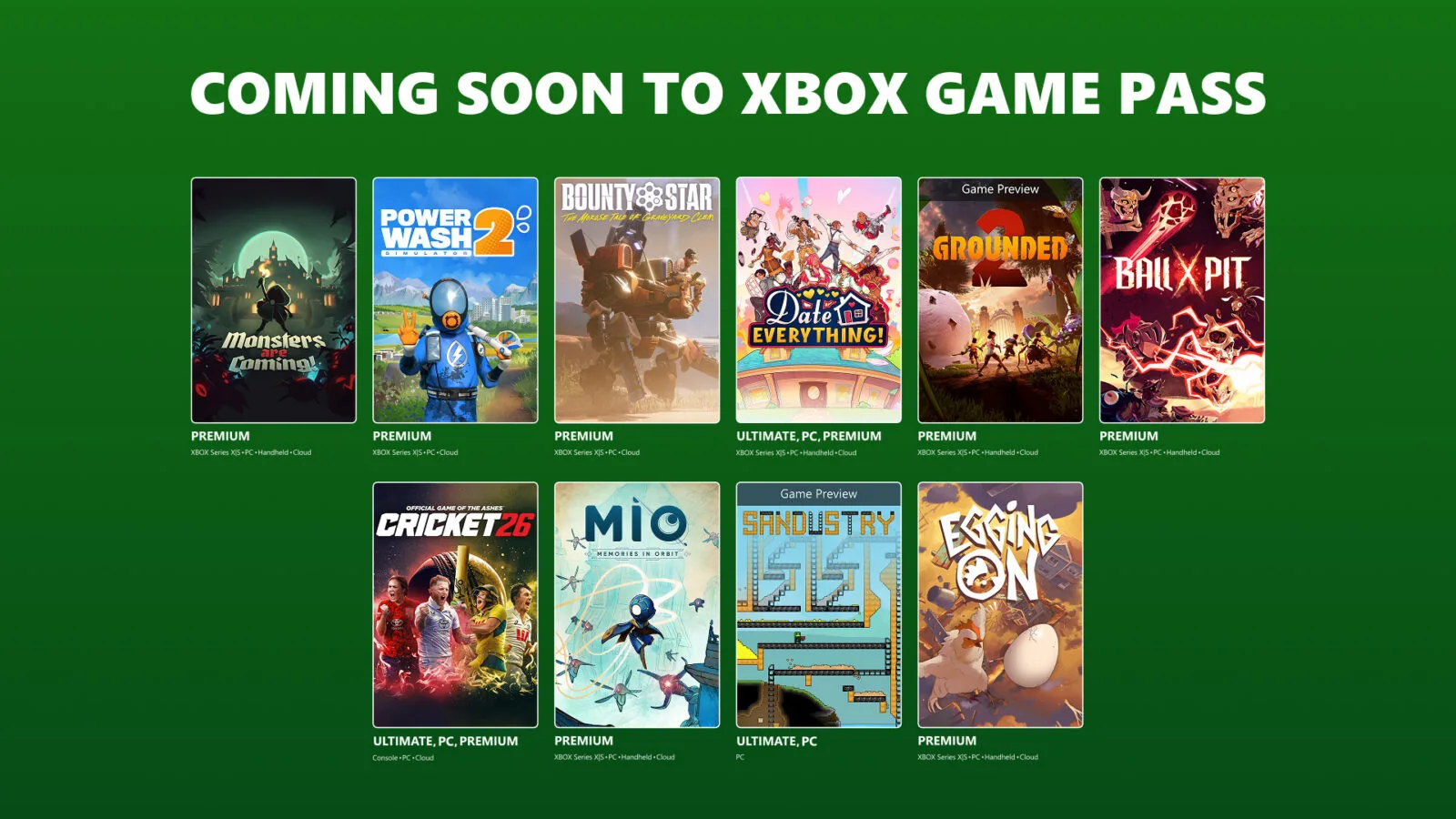
Premium also changes every month. In the August 2026 first wave alone, Xbox described eight titles as moving into Premium after already appearing in Ultimate and PC Game Pass: Heretic + Hexen, Monsters are Coming!, PowerWash Simulator 2, Bounty Star, Grounded 2, Ball x Pit, Mio: Memories in Orbit, and Egging On. That migration steadily reduces some older timing gaps while new day-one releases open others.
The sensible Premium test is therefore qualitative. List five to ten games you genuinely expect to play during the next billing period. If they are all in Premium on your platform, Ultimate’s larger abstract count may not improve your actual month. If several depend on EA Play, Ubisoft+ Classics, day-one access, or a higher cloud-service level, the cheaper catalog stops being equivalent.
Do not compare plans with a “best games” article that silently assumes Ultimate. Recommendation lists often mix tiers and platforms for convenience. Begin with the current recommendations, then verify each promising title against the plan filter and Store page. That two-step process preserves discovery without turning an editorial pick into an access guarantee.
How to check whether your games survive a downgrade
- Write a personal queue. Include installed games, active co-op campaigns, and the next few titles you intend to start. Ignore hundreds of games you were never going to launch.
- Match the exact product. Search the live catalog for title and edition. A deluxe bundle, separate PC version, or cross-generation package can have a different entitlement from the base game.
- Filter Premium and your platform. A Premium badge is not enough if the only available record is for PC and you play on console. Cloud support is also its own capability, not proof of a downloadable version on every device.
- Check the departure date. A game can appear in both plans yet leave the service soon. Review the leaving-soon list so you do not blame a downgrade for a catalog-wide removal.
- Separate licenses from extras. Owning DLC, currency, or an expansion normally does not replace access to the required base game. Confirm a purchased base-game license before assuming it will launch after the plan changes.
Perform the audit before changing recurring billing, then capture the plan and Store listing for your own reference. Xbox says catalog access continues only while the relevant membership is active and the game remains in that library. An installed file does not bypass the license check after an entitlement ends.
Progress data and access are different questions. A save may remain on the account or device, but it cannot make an unavailable game launch, and compatibility can vary between editions and platforms. If a campaign matters, verify the publisher’s cross-save or Play Anywhere rules before switching versions. The safe promise is that downgrading changes access; it is not that every save automatically transfers to every replacement edition.
Is Ultimate or Premium better for you?
| Your priority | Better starting point | Reason |
|---|---|---|
| Major games on release day | Ultimate | General day-one access is an Ultimate benefit; Premium waits for selected later additions. |
| EA and Ubisoft back catalog | Ultimate | EA Play and Ubisoft+ Classics are included on the Ultimate side. |
| A known queue already in Premium | Premium | The larger Ultimate set adds little if you will not use it this billing period. |
| Best available cloud service level | Ultimate | Xbox positions Ultimate for its highest cloud quality and shortest waits, subject to device, region, and network. |
| Patient console/PC catalog play | Premium | Its rotating library, cloud access, and online console multiplayer can cover a backlog without day-one timing. |
Ultimate is the safer default for a player who uses several bundled benefits at once. One day-one release, regular EA Play use, Ubisoft+ Classics, and cloud play can create combined value that no single game count expresses. It is also the less fragile choice for a mixed console-and-PC household, although each title still needs a platform check.
Premium is the disciplined choice when your real queue fits its catalog. Compare the incremental subscription cost in your region with the price and time value of the games you would otherwise lose. In the US, Xbox changed Ultimate to $22.99 per month in April 2026, but regional prices, taxes, offers, and later changes mean the checkout page controls. Use the current plan page before acting.
Ultimate vs Premium games FAQ
Is every Premium game included with Ultimate?
Every playable Premium game in our August 11 US snapshot had a matching playable Ultimate record. The same subset relationship held across all non-left tracked entries. Treat that as a dated database result, not an eternal rule; recheck the live plan filters for your region and platform.
Do I lose my installed games when I downgrade?
The files may remain installed, but a game that is not licensed by Premium will no longer launch through that subscription after the entitlement changes. A separate purchase can provide a continuing license for the correct edition and platform.
Do I lose my saves?
Losing catalog access is not the same as deleting progress. However, save storage, cross-save, and compatibility vary between games, platforms, accounts, and editions. Verify the game’s support rules before relying on a future purchase or different version.
Can Premium stream games it does not include?
Xbox supports streaming selected owned games under current cloud rules, but the game must be in the supported owned-game cloud library and purchased separately. That is different from a Premium catalog entitlement and still requires supported devices and regions.
Why does the exact games count change?
Games join, migrate between plans, and leave; editions and platform records also affect counting methods. Xbox explicitly says titles and numbers vary by time, region, plan, and platform. Use exact counts as dated snapshots and use the benefit comparison for structural differences.
Comments
Comments are reviewed before publication. Please keep the conversation helpful and on topic.
Sign in with Google to leave a comment.
Loading comments…